Alaska video and audio blog. This vlog expose' depicts the cultural life and times in rural Alaska relating rural issues and trends. All observations collected by the people who live here in Alaska. alaska rural education culture sport politics vlog blog weblog video audio vodcasting podcasting
Journey with the 5 year old twins, Mian'aq and Nuq'aq Alexie-Leonard, to the Tuntutuliak traditional fishcamp...take a tour to the Kuskokwim River and expose yourself to: Fish Camp Essentials
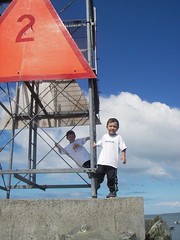
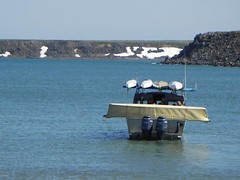
Nuq and Mian at Mekoryuk Harbor, Nunivak Island
VIDEO ARCHIVES (flash video)
To Fish Camp...Nuq and Mian along with videographer Skip Snaith head 20 miles downriver from the hub community of Bethel to Katie and Nels Alexie's site at Tuntutuliak Fishcamp. Nuq leads us on an exploration of the puyurcivik or 'smokehouse' and the maqivik or traditional 'steambath'.
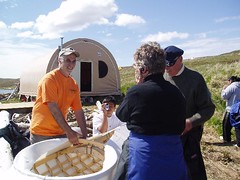
Maurluq 'Grandma' Katie Alexie Cutting King Salmon,Tuntutuliak Traditional Fish Camp, Kuskokwim River Kuskokwim River, SW Alaska.
music from Windham Hill, The First Ten Years, Mike Marshall and Darrel Anger track entitled "Dolphins"
Apa'urluq 'Apa' 'Grandpa' Nels describes the fine art of smoking fish to guest videographer, Skip Snaith
Fish Camp Store, provisioning in the 'bush...Apa' Nels has a store!
Apa' Nels Alexie, Mian'aq and Nuq'aq...Fish Camp Schooling. Even young chidren are given meaningful tasks at camp...here, the boys are responsible for cutting wood for the maqivik stove which will be fired up for the evening bath.
_________________________
SWITCH
To many non-Indian observers, including policymakers, subsistence is nothing more than a cultural antique -- an increasingly ineffective holdover from previous times that will inevitably disappear as market economies take over. However, subsistence is not a relic from the past. It has and continues to be the foundation of Alaska Native societies. Today, the subsistence way of life is necessary for the physical, cultural and economic survival of Alaska Native people.
Most of the 220 small Native villages in Alaska are located on or near the shores of a river or a lake, or on the coasts of the North Pacific, Bering Sea, or Arctic Ocean. The proximity to water is no accident and reflect s the dependence of Alaska Natives on the harvest of fish stocks for sustenance and the basis of their traditional way of life. In many Native villages, fresh meat, fish, and produce are unavailable except through the subsistence harvest.
Yet, as important as hunting and fishing rights are to the physical, economic, traditional, and cultural existence of Alaska Native people, the Alaska legislature refuses to recognize the importance of the subsistence way of life. The State views subsistence as nothing more than the taking of a natural resource, and as something that all citizens of the state should be entitled to engage in on an equal opportunity basis with little distinction between sport and trophy hunting and subsistence needs.
Under a federal law that protects Alaska Native subsistence rights, the State's refusal to recognize the subsistence priority requires the takeover of subsistence fishery management by the federal government. However, despite a court order mandating that the federal government implement this priority, Alaska's congressional delegation and the Department of the Interior have stifled this mandate for several years in a row, by agreeing to moratoriums which deny funding for this critical federal takeover. [exerpted from: http://www.ewebtribe.com/NACulture/articles/alaskasubsis.htm]
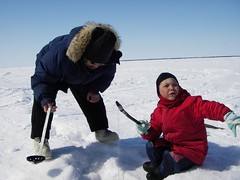
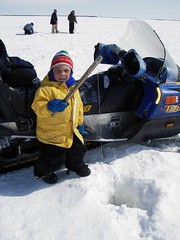
Travel with 'the twins...five year old Nuq and Mian travel down the Kuskokwim to Tuntutuliak Fishcamp for spring-time ice fishing...catching Pike and enjoying the spring-time weather.
Boys travel about 20 miles with a snow-machine to where the Johnson River flows into the main channel of the Kuskokwim. Trails are hard snow pack, temperature ~20dF ambient and the sun is shining.
Holes are drilled in the ice and gigging lures with blackfish parts as additional bait attract Pike to the boys lines...lots of fun is assurred! Good eating too!
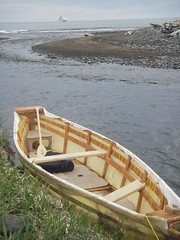
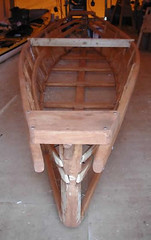
Skip Snaith, the staff and students at Nash Harbor Science and Technology Camp created this magnificent boat. Not only was it a work of art but it became the primary work boat for the Nash Harbor Camp.
The boat was constructed out of yellow cedar, complete with plywood flooring and a Dyson Baidarka nylon skin covering. The boat is both hand tied with some traditional brass fittings and rivet structural components.
The North American Indian by Edward S. Curtis is one of the most significant and controversial representations of traditional American Indian culture ever produced. Issued in a limited edition from 1907-1930, the publication continues to exert a major influence on the image of Indians in popular culture. Curtis said he wanted to document "the old time Indian, his dress, his ceremonies, his life and manners." In over 2000 photogravure plates and narrative, Curtis portrayed the traditional customs and lifeways of eighty Indian tribes. http://memory.loc.gov/ammem/award98/ienhtml/special.html
View a slide show of Curtis' documentation during a visit to Nunivak Island, circa 1927, people, places and things!
Music: Phillip Aaberg, Theme for Naiomi Uemura, from Windham Hill Sactuary